
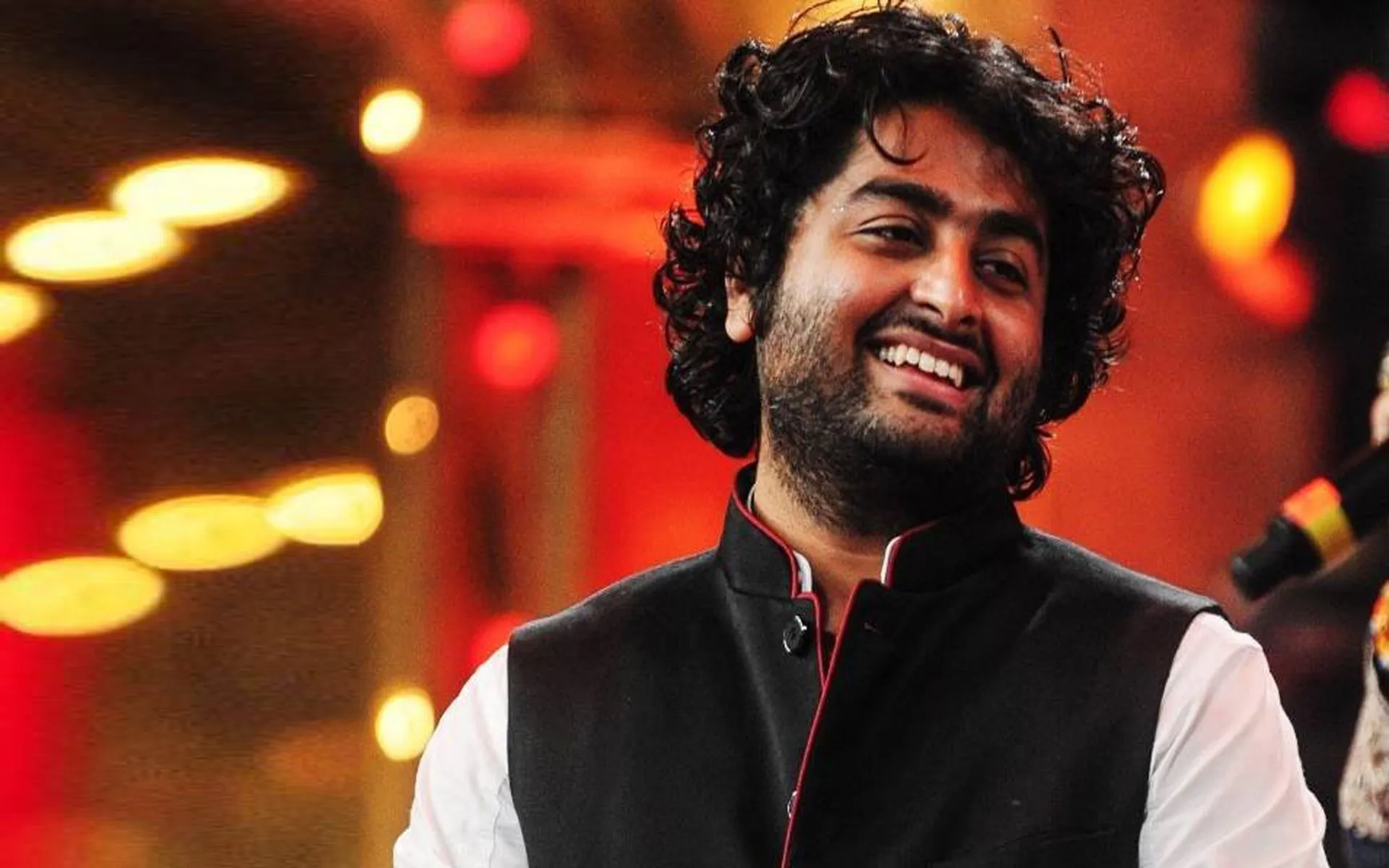
Sometimes the silences matter more than the loudest applause. When a voice that has traveled with millions decides to rest, the space it leaves is not a gap in a playlist, but a pause inside the listener. Arijit Singh has chosen to step away from new playback assignments, and with that choice an entire period of film music seems to take a breath. This is not simply a career move. It is the conclusion of a powerful conversation that one singer held with an entire generation through melody, restraint, and presence.
His message arrived without spectacle. No staged announcements. No countdowns. No media parade. A short note of gratitude and closure was enough. He thanked listeners, acknowledged the long path that had carried him, and said the work felt complete. He did not dress it up as an event. Yet the aftershock flowed in every direction. Admirers were stunned. Composers and musicians wrote tributes. Listeners spoke of personal moments that his songs had underlined. In a culture that often confuses volume with depth, this was a reminder that the most transformative signals can be quiet.
A turn in how romance sounded on screen
To understand why this decision feels so weighty, one has to return to how film romance evolved during his rise. Before his arrival, the mainstream sound of love in Hindi films leaned toward the grand. Emotions were painted in full color, often with sweeping crescendos and open declarations. It was a language that filled stadiums and gave audiences a sense of cinema as spectacle. Then came a different approach. He did not try to tower over the scene. He brought the voice closer to the ear of the listener, almost as if speaking in confidence rather than performing to a crowd.
When his breakthrough romantic song released in 2013, it did more than top charts. It introduced a different temperature to on-screen affection. Vulnerability took center stage. Softness replaced strain. Emotion did not need to shout to be heard. The track’s success encouraged filmmakers to let intimacy lead, and in the years that followed, a steady wave of love songs arrived with his signature touch. Directors sought him for the moments where feelings spill without speech. Audiences began to trust that if his voice entered a scene, the heart of the story was about to be revealed.
Consistency that turned songs into life companions
What deepened his influence was not a single moment, but an unbroken thread of work that felt reliable. Year after year, he delivered songs that slipped into daily routines. People found them echoing at weddings, running through road trips, humming late at night when sleep would not arrive. These tracks did not rely on gimmicks. They carried honesty. Whether the mood was ache, reunion, hesitation, or hope, he made the feeling seem unforced, like a thought you discover while looking out of a window.
Listeners did not just enjoy the tunes. They trusted them. They felt that the person singing had lived the emotions he was describing, or at least had the patience to understand them. That trust is rare, and it cannot be faked. It is born from showing up again and again with care, and letting the music speak without the distraction of persona.
Fame without the costume of fame
At a time when celebrity often depends on constant exposure, he chose a different route. He kept away from the glamour cycle. He opted out of building a public image designed to stir headlines. Interviews were few. Controversies were avoided. His life seemed to orbit family and work rather than pageantry. Paradoxically, that restraint made his appeal stronger. Listeners sensed sincerity. They believed the person behind the microphone valued the craft more than the crowd.
That distance did not make him unreachable. It made him relatable. People trusted the music because the messenger did not appear distracted by noise. In a culture motivated by presence, his strategic absence became part of the story.
Learning the trade before touching the spotlight
From the outside, some careers look like sudden ascents. His path was slower, and that slowness became a foundation. He first appeared as a young participant on a reality singing program. Talent was evident, but fame did not instantly follow. Years passed in studios and rehearsal rooms. He worked as a chorus voice. He learned programming. He explored arrangement and the engineering side of recording. He listened to how songs are built from the inside out. That long apprenticeship gave him a toolkit that few vocalists possess before they become public.
So when opportunity came, he was not just an interpreter of melodies. He was a builder. He could hear how a vocal phrase sits against a chord, how breath can be used as a texture, how restraint can generate power. The discipline he internalized is part of why his delivery seemed measured without being cold, and intimate without being fragile.
Grace under pressure and conflict
No extended career escapes friction. He had a widely noticed disagreement with a leading film star, which meant he did not sing for that actor for a period. The press followed every rumor. Debates bloomed online. Yet he did not escalate the matter with public barbs. He avoided turning it into theater. In time the tension eased, and they collaborated again. That resolution mirrored his broader method. He stayed focused on music, not noise. The art remained at the center, and storms passed.
Crossing languages and blending traditions
Although Hindi cinema gave him national reach, he was not bound to a single industry. He recorded extensively in Bengali and Assamese, and pursued independent releases that stood outside film scripts. In each context, he adapted. He paid attention to local phrasing and musical traditions, which kept his work from sounding transplanted. This flexibility expanded his identity from a Bollywood presence to a pan-Indian musician whose voice could belong in many rooms.
Why leave when demand remains high
This is the question that troubles many who admire his work. He remains in demand. The voice still carries the warmth and control that made it a fixture. The fan base is unwavering. Why then choose to step back? His note pointed toward fulfillment rather than fatigue. Some artists stay until time or decline makes the decision for them. Others recognize a natural closure while the work still feels whole. He appears to have chosen that second path. It is a choice that speaks of intention, and of respect for the journey.
In creative life, knowing when to finish can be as vital as finding the first note. Endings shape memory. By drawing a line while still strong, he turns a long run into a complete chapter rather than a lingering fade.
What changes for film music now
For more than a decade, many of the most memorable screen romances leaned on his interpretation. With his absence from new playback, composers and filmmakers will look to fresh voices. That search is not a crisis. It is an invitation. New singers will find space. Producers will experiment with tonal palettes that build intimacy in different ways. His recorded work will not vanish. It will continue to play at celebrations, on commutes, and in quiet rooms where people turn to familiar songs for comfort. But gradually, the texture of romantic film music will evolve.
That shift will not erase what came before. It will sit next to it, the way every era places its own language beside the previous one. A generation learned to express affection and loss through his timbre. The next generation will discover its guides. This is how cultural memory grows. It is not a zero sum game. It is a river with many streams feeding it.
The craft that listeners felt but did not always see
To appreciate his legacy, it helps to notice the method behind the emotion. He rarely rushed a line. He allowed rests to breathe, and that breathing gave the words weight. He shaped vowels softly. Consonants never felt hammered. Dynamics rose and fell like a conversation rather than a monologue. These choices communicated intimacy even in large arrangements. They drew the ear inward. The result was a sensation that the singer was not pushing the feeling onto you. He was inviting you to remember your own.
This approach also served the film narrative. In sequences where characters were not ready to speak or where dialogue would seem heavy, his voice filled the emotional gap without intruding. The song became an inner monologue. Viewers did not just watch the characters. They occupied their thoughts. That is a delicate function that not every vocal performance can carry. His consistency in delivering it made him indispensable to storytellers who valued nuance.
Audience intimacy in the era of constant access
Streaming changed listening habits. Music began to live in pockets and headphones, often at the edge of night or on the path to work. He thrived in that environment. His songs felt at home in private spaces. The melodies did not demand attention through volume. They held it through closeness. That trait allowed his work to bridge cinema halls and daily routines. You could leave a theater with a tune in your chest, and it would find you again later on a bus ride or at a desk under a lamp. He became the soundtrack of unsaid thoughts.
A farewell that honors the listener
By writing a modest message and stepping aside without drama, he honored the people who carried his music all these years. He did not frame the decision as a cliffhanger or a test of loyalty. He simply said thank you and indicated that this part of the road felt complete. That clarity freed listeners from guessing games, and it allowed them to hold the catalog as a whole story rather than a series of teasers for what might come next.
There is also dignity in not turning an ending into a tour of nostalgia. He did not announce a long goodbye designed to stretch attention. He chose a simple close. This choice fits the pattern of his career, where the work always stood taller than the spectacle around it.
What remains, and what begins
He has not retired from music altogether. He has decided not to take on new playback singing for films. That still leaves room for other creative paths. Independent projects can continue. Collaborations outside traditional playback are possible. Live performances can persist. But the change is real. A defining voice in the film world has stepped out of the queue for new screen stories. That space will call new names, and the industry will adjust, as it always does.
What remains is a body of work that traveled through countless lives. Songs that helped people confess feelings. Tracks that became the background to proposals or partings. Melodies that played in living rooms on quiet afternoons. That archive is not going anywhere. If anything, the decision to end this chapter might sharpen how people hear those songs. Listening now, one can recognize the arc, the patience, the values that shaped the music. It is a complete sentence rather than an ellipse.
Lessons from a mindful exit
Artists often grapple with two urges. One is to keep creating in the same lane because it feels safe and welcomed. The other is to move on when the inner compass says the circle is closed. By choosing completion over continuation, he offers a different model of success. It is not only about how high you climb. It is also about how clearly you choose your last step in a given direction. That clarity protects the legacy. It also frees the artist for whatever follows, even if the next path remains undefined.
For listeners, there is a parallel lesson. Music is a living exchange. We bring our stories to it, and it brings its stories to us. When a beloved voice pauses, it invites us to revisit what that exchange gave and to notice how we have changed since the first time we heard it. This is a chance to listen again, not just to the songs, but to the person we were when those songs first found us.
Frequently asked questions
Why has Arijit Singh decided to stop playback singing?
He shared that the journey of playback singing feels complete to him. The choice comes from personal intention rather than pressure or decline.
Does this mean he will stop making music altogether?
No. He has said he will not take on new playback projects. Other forms of music can continue outside film playback.
How did his career begin?
He first drew attention through a reality singing show, then spent years in studios working behind the scenes as a chorus voice, a programmer, and a learner of composition and recording. That long preparation shaped his later work.
Which song first made him widely popular?
A romantic track released in 2013 brought national recognition and set the tone for his later influence in film music.
Did he only sing for Hindi films?
No. He recorded extensively in Bengali and Assamese and also released music outside the film industry.
Is this retirement permanent?
He has described it as a final decision regarding new playback assignments. Other musical directions remain open.
How have people in the industry reacted?
Reactions have centered on surprise, gratitude, and respect for his long contribution to cinema and to listeners across the country.
Will older songs still be heard in new contexts?
Yes. His recorded work will continue to stream, to be used in various settings, and to accompany personal moments for years to come.
A closing thought
Every period in cinema has a handful of voices that teach audiences how to feel with music. For this generation, he is one of those anchors. His decision to step back is not the end of music, but the completion of a chapter that will keep resonating. The playlists remain, the memories remain, and a door quietly closes so that others can open. In choosing the right moment to stop, he reminds us that endings can be generous. They can protect what we love by leaving it whole.