The Moment That Shattered Expectations
Fashion lore often sits in archives and coffee table books, but every so often a look steps out of the past and refuses to fade. On June 29, 1994, the Princess of Wales arrived at the Serpentine Gallery wearing a short black dress that carried more force than any press briefing that day. It was not simply a party outfit. It was a statement crafted with precision, delivered at the exact second the world was already watching. The effect was immediate. Headlines pivoted, cameras locked in, and a new chapter of royal image-making began the instant she took her first step onto the gravel.
What Led Up To The Choice
The plan for the night had been tidy and predictable. A gown by Valentino had been landed for the appearance, a respectable selection that nodded to protocol and good taste. Then the house announced the look to reporters ahead of time. That breach in discretion, under ordinary circumstances, might have prompted a muted scolding and no change of plan. But nothing about that day was ordinary. As the evening unfolded, the nation watched a television interview in which the Prince of Wales acknowledged infidelity. The palace’s public posture tilted toward damage control and somber regret. In that atmosphere, the expected wardrobe felt like a costume written by someone else.
Instead of retreating, she reached for a dress that had lived in her wardrobe for years without a public outing. The piece was by Christina Stambolian, a Greek designer with a talent for drama and clarity of line. It had been purchased in 1991 and set aside because it seemed too daring for a princess. On this particular night, that quality was exactly what made it right. She chose to show up rather than disappear. She let photographers do their work. No tears. No apologies. The visual spoke for her, and it outshined the competing narrative playing on television screens across the country.
Arrival As Strategy
Weather may have been sticky and the crowd dense, but those inconveniences only amplified the theatrics. She stepped out of the car with a calm expression and an economy of movement. The dress, cut to flatter and to glide, worked with every turn of the shoulder and tilt of the chin. In that choreography, you could see calculation, not in a cold way, but in a way that recognized the stakes. She understood the cost of letting others define her. She understood how quickly an image can eclipse a paragraph of excuses. The sequence lasted seconds. Its echo has filled decades.
Why The Look Landed With Such Force
Commentators sometimes reach for lofty theory to interpret that evening, but the core is straightforward. A woman who had been framed as fragile chose to broadcast authority. After years of being treated as an ornament in stiff suits or prim florals, she pivoted to a silhouette that felt alive, sharpened, unafraid. The hemline and neckline did more than highlight a figure. They made clear that she could write her own script, even while trapped inside an institution that preferred predictability.
Timing amplified meaning. She appeared exactly as the public was processing the Prince’s admission. The next morning, the subject that dominated conversation was not his contrition. It was the photograph of a woman in black silk, head high, pearls at her throat, stepping into her own light. It read as a breakup masterclass without a word spoken. It taught a simple lesson about power. Control the frame, and you control the story.
Inside The Stambolian Design
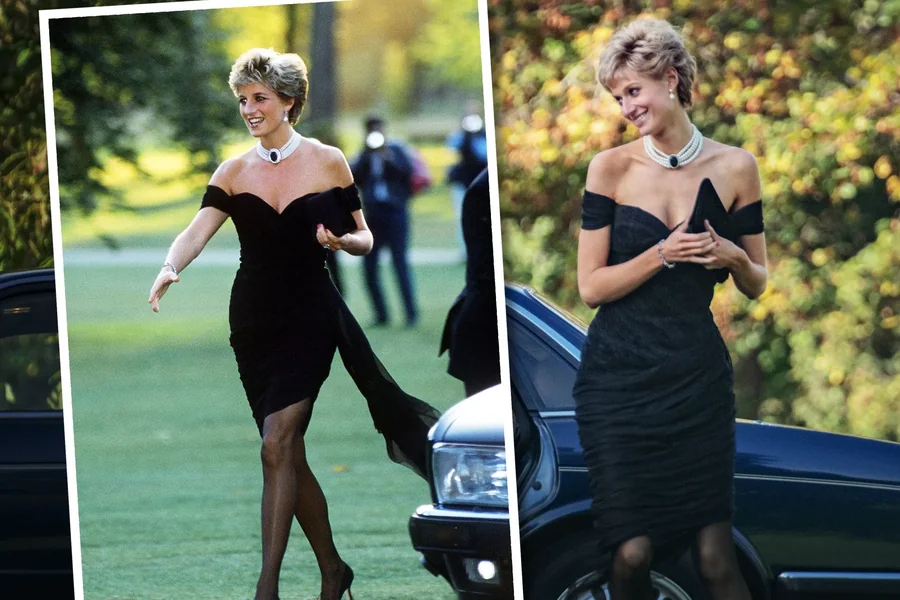
The construction mattered. Stambolian’s design did not drape limply. It was made of substantial silk crepe that embraced the body, then released into movement. The neckline formed a deep curve that directed attention to the face and to the striking necklace. The skirt wrapped and angled, creating an asymmetrical line that lengthened the leg and added urgency to every stride. Attached at the back, a chiffon train followed like a breath, catching air and light to leave a lingering impression a beat after she passed by. No modesty panels. No high, shielding collar. The message was clear. This was not a uniform for duty. It was a garment for announcement.
That clarity carried through in how the dress was styled. The look was not cluttered with trinkets. One piece of jewelry anchored everything. It was a seven-strand pearl choker centered by a sapphire, originally set in a brooch given by the Queen Mother. In that one choice she blended continuity and reinvention. The lineage of the jewel remained visible, yet the arrangement felt modern and defiant. She wore history like armor, but on her terms. The ensemble had the precision of a thesis. Nothing was random.
In later years the gown fetched seventy-four thousand dollars at auction. The figure does not begin to measure its significance. The sale was a footnote compared to the value extracted the instant bulbs exploded around her. That night the dress bought more than headlines. It bought freedom from the narrow part assigned to her in a very public drama.
Color, Fabric, And The Language Of Rebellion
Black carries specific meaning in royal settings. It is usually worn for solemn occasions or mourning. To appear in a short black dress at a summer arts event flipped that code on its head. It read like a ceremonial farewell to a marriage, but it did not resemble sorrow. The sheen of the silk made her look vital under flash photography. In contrast, the televised image of the Prince felt gray and heavy. The visual difference told a story that language could not match.
The train functioned like a victory banner rather than a bridal echo. Each step unfurled confidence. The cut created a V shape that focused the gaze upward, locking the viewer to expression and adornment. Against a decade of prim looks, this felt like a door slamming on an old image and a new door swinging open at the same time. The dress was not costume for a role. It was a costume for freedom.
Media Mastery In Real Time
For years the tabloids had gnawed at her private life. She learned how to survive in that environment by turning exposure into leverage. She did not hope for good coverage. She curated it. By choosing a high-profile venue on a night when editors hungered for a competing image, she made their jobs easy. The composition was flawless, the lighting merciless in the best way, the pose unflinching. By sunrise the front pages were not consumed by contrition. They were consumed by that entrance. People sometimes bristle at the idea of calculation, but public figures who do not calibrate their image get steamrolled by those who do. She won because she understood that power in modern life often lives in a frame.
From Private Pain To Public Playbook
The dress became a template. Any time a high-profile breakup plays out and an actor or singer shows up at a premiere in a razor-sharp black gown, they are echoing the formula from that 1994 evening. The fashion world spins stories of novelty, yet the basic recipe keeps returning. Elegant shape. Strategic skin. Calm expression that says the worst is over and the future looks good. The moment rewrote expectations for how a royal could present herself. It suggested that clothing could be more than a display of taste. It could be a shield, even a blade.
Designers still chase that balance of poise and provocation. You can spot the influence in asymmetrical hems and decisive necklines on runways, in editorial shoots that frame the subject as author rather than ornament, and in seasonal collections marketed as reclaiming power after heartache. Few fashion moments withstand cultural churn. This one does because it skips costume and goes straight to survival. Young audiences continue to analyze the look because it captures the feeling of stepping into the center of your own story after being sidelined for too long. It is the reference point, and much of what follows feels like a cover version.
Why The Story Still Resonates
People keep returning to that image because the emotion behind it is universal. Most of us know what it is to be written off, to be cornered by a narrative we did not author, to want one clean moment that says enough. She had to perform that pivot under brutal scrutiny. The dress turned a personal low into a public reset. That is why the scene has not dimmed with time. It carries the charge of reinvention, not as a slogan but as an act.
Perfection had nothing to do with it. She was complicated and likely exhausted. That humanity lingers in the pictures. You can feel steel wrapped around vulnerability. The outfit crowned that mix rather than hiding it. The message was not I am faultless. It was I am finished playing the part you wrote for me. That makes the memory durable, because change born from clarity usually is.
Reading The Details Without Overreading The Myth
The story works on a practical level. A trusted dress waited in the closet for the right event. A scheduled outfit fell away after a publicity misstep. The media window was prime. She seized it. Yet the myth grows because the details all aim in the same direction. Every line of the garment, every glint off the pearls, every flash from the cameras repeated one point. Agency. The look did not apologize or ask for permission. It refused to surrender stage time to a different narrative unfolding across town. That clarity is why the photographs still hum with energy when you see them today.
How The Valentino Swerve Framed The Night
The decision not to wear the previously selected Valentino matters because it defined the tone. The leaked information turned a safe choice into a symbol of doing what was expected. Abandoning it opened space for risk. The shift told everyone paying attention that the script had changed. That act alone would have created ripples. Paired with the televised confession, it created a riptide. Audiences saw her reject predictability. She did it with a smile and a dress that glided like a challenge.
The Jewelry As Message
The seven strands of pearls and that sapphire were not merely decoration. They were lineage translated into modern punctuation. The brooch gifted by the Queen Mother found new life in a setting that suited the times and the woman wearing it. Old-world gift. New-world styling. The combination read as continuity without captivity. She did not need to discard the past to own the present. She needed to wear it differently. The necklace drew the eye up, ensured photographs would frame her expression tight, and crowned the look with authority.
Afterlife Of A Dress
When the gown sold at auction for seventy-four thousand dollars, the price made headlines, but the cultural value was already immeasurable. The look had achieved something most clothing never does. It leapt off the hanger and into the public imagination. It continues to travel. Exhibitions borrow it. Writers revisit it. Stylists reference it for clients who want to appear unbothered after upheaval. The fabric and stitching remain the same, yet the garment gathers meaning each time the photographs circulate.
Lessons In Image And Power
The evening teaches straightforward principles that apply far beyond fashion.
- Know the room. She chose a venue and moment when a single image could reroute conversation.
- Use simplicity. The look worked because it had one dominant message rather than noise.
- Honor the past on your own terms. The repurposed brooch turned heritage into strength.
- Accept that visibility can be armor. She did not hide. She used attention as a resource.
- Understand that timing is everything. The entrance landed at the exact second the narrative was malleable.
Those rules are not tricks. They are the architecture of modern influence. She saw it and built with it before many in her circle recognized the blueprint.
Why Topping It Feels Unlikely
Could anyone outdo that moment. Probably not. Replication would require the same convergence of personal stakes, institutional pressure, media appetite, and a look that embodied rebellion without reading as costume. The 1994 appearance lives at the intersection of those forces. It is lightning in a bottle. Many have borrowed its electricity. None have captured the full storm.
Frequently Asked Questions
Who designed the dress often called the revenge look
It was created by Christina Stambolian, a Greek designer known for confident, dramatic silhouettes.
When did she wear it
She wore it on June 29, 1994, the same night the Prince of Wales publicly acknowledged adultery on television.
How much did the dress sell for later
It sold for seventy-four thousand dollars at a 1997 auction held before her death.
Is the dress in a museum now
It is privately owned and is frequently loaned for major fashion exhibitions.
The Enduring Legacy
The essence of that night was not silk or stones. It was refusal. She would not fade into the background of someone else’s apology tour. She chose to be visible, to be composed, to be unmistakably herself at a moment when many expected contrition or retreat. The dress carried that choice into every household that opened a newspaper or watched the evening news. It continues to stand as a signpost for anyone who has been cornered by expectation and wants to step out of it.
In the end, the look persists because it translates a private decision into a public language we all understand. Enough. I will be defined by what I do next. That is the legacy stitched into every seam of that black Stambolian dress and strung through every pearl at her throat. Decades on, the image still does what it did in real time. It seizes the frame. It tells the story. And it refuses to let go.